Previously featured squadron
396 City of Prince George Squadron
- Chartered
- January 5, 1948
- Status
- Active
- Community
- Prince George, BC
Squadron History
The 396 City of Prince George RCACS received its charter to operate as a Squadron in BC on January 5, 1948. Since its formation, the ‘City of Prince George’ Squadron was fortunate to have sponsors, officers, and instructors whose prime interest has been to provide facilities and gentle leadership guidance that encouraged the Cadets to run their own show. Senior Cadets make decisions (within policy guidelines), and form the majority of the instructor’s cadre. Learned leadership theory is put into practice. The Cadets have been encouraged to provide for themselves rather than simply become the recipients of handouts.
Over the years, they (with help) have raised funds to provide a 13-acre lakeshore survival training area, a flight simulator-training unit, a glider jointly owned with other northern squadrons, a glider trailer, and many other items of need.
Available records show the first home of the squadron to be the DND Armories in Prince George. After the closing of the Prince George Armories in 1971, the 396 City of Prince George Squadron was without a facility it could call home. For a while they paraded out of the basement of the Royal Canadian Legion Branch 43 until 1982 when the Legion leased a partially burned-out school from the city. The squadron was offered a gutted third-floor area that had been condemned by the Fire Marshall. The hours of work and the money needed to make this hulk even usable was tremendous, but the 396 Cadet Community thought they could do it — and they did! The result is one of the nicest Cadet office/training areas in the province.
The job of the sponsors and training staff is to provide the best possible environment for learning so the Cadets can excel both as individuals and as a group. That is and always has been the common aim and goal of adults connected with the squadron. How does a unit achieve these goals? Like any good recipe, there is a combination of several ingredients in differing amounts carefully mixed together. On their own, the ingredients do not spell success but properly combined they can produce splendid results. The ingredients are common enough and available to everyone. They can be very expensive, but in fact, cannot be purchased for money. Dedication towards a common set of goals which are challenging but attainable; a full measure of co-operation among everyone involved; enough sustained enthusiasm and effort to maintain interest; and sufficient personal satisfaction and pride in accomplishments to elicit continued participation. In short, ‘Esprit de Corps!’
In its history the squadron has produced numerous Flying Scholarships, Gliding Scholarships, Senior Leader graduates, and Exchange Visit candidates — a record any group of this size can be proud of. Since its sparse beginnings decades ago, many hundreds of young Prince George men and women have been introduced to the obligations of citizenship and the basics of leadership. They have gained some knowledge and experience in flying and related subjects, while at the same time being kept physically active and fit. Many have gone on to serve their country with distinction in the Canadian Forces. Others have contributed significantly to the community in many ways. Most look back upon their days in Air Cadets with fondness and respect for the movement. The highest compliment a squadron can receive is to have the son or daughter of a former Cadet introduced into the squadron by their parents.
The Story Behind the Squadron Crest
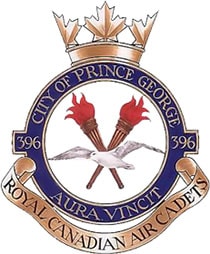
The 396 RCACS Squadron Crest was created by a past Cadet of the squadron named Paul Thobo-Carlsen. Paul joined the squadron in 1979 at the age of 15, a few years before the squadron moved into the Connaught Youth Center. Below is his story on how he created the Official Squadron Crest.
“When I joined the Squadron there was no official badge (crest), and because I had an interest in heraldry and dabbled in drawing, I decided to take a crack at creating one. I recall obtaining a generic template used for Royal Canadian Air Cadet badges (the circular frame with Maple Leaf cornet on top and motto scroll on bottom). In those days, well before the internet, all my research was book-based. I recall going through lots of library books and encyclopedias for ideas and inspiration.
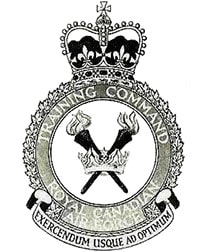
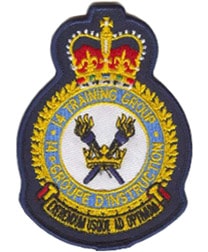
I recall seeing an old RCAF badge that featured two crossed torches. I believe it was either Training Command (Trg. Comd) or its successor 14 Training Group (14 Trg. Gp). The meaning of lamps and torches in heraldry is learning (i.e., ‘enlightenment’). I thought that was a good symbol to represent a key aspect of the Air Cadets.
I chose an airborne gull to place in front of the torches to represent flying, a main component of the Air Cadet program (I was lucky enough to get both my glider and private licenses through Air Cadets, and later my glider instructor rating as a CI). Although the typical bird used in RCAF heraldry is the eagle, I chose a gull since they were very common in PG and therefore represented the local community better in my opinion.
The Latin motto, ‘Aura Vincit’, means ‘air conquers’ or ‘victory through air.’ This is meant to show that through flying (fam flights, glider/flying scholarships, etc.) Cadets can conquer adolescent inhibitions and build confidence in their abilities.
I don’t recall the exact year that I completed this design and submitted it to the CO for consideration — it was probably 1980 or 1981. I’m pretty sure it was approved and in unofficial use before I turned 19 in the summer of 1983. As I recall, the Squadron had to send my colour design drawings up the Air Cadet chain of command for final approval to Ottawa. I attended a 396 Squadron reunion back in 2008. Lt. Col. (Retired) Don Doern (former Squadron CO, 1982–86) had just moved into a smaller home and was happy to pass on his framed print of the Squadron badge to me. So now, I finally have my own copy.”
The two RCAF badges that inspired the crossed-torch design are shown below — RCAF Training Command (1949–1958) and CAF 14 Training Group (1958–1966).
Squadron Records
2024 Squadron Organization
| Role | Name |
| Commanding Officer | Lt Deb Mortimer |
| Deputy Commanding Officer | Capt. Eric Callaghan |
| Training Officer | Capt. Dale Evasin |
| Administration Officer | CI Karla Weller |
| Supply Officer | Capt. Eric Callaghan |
| Training Assistants | Lt Erik Fjellgaard · CV Aimee Glaubitz |
| Administration Assistant | Capt. Cheryl Jackson |
2024 Sponsoring Committee (SSC)
| Role | Name |
| Chair | Sherilynn Porter |
| Treasurer | Janine Friberg |
| Secretary | Richard Stuetz |
| Screening Coordinator | Anne Bonshor |
Commanding Officers
| Tenure | Name |
| 1947–1952 | Flight Lieutenant DJ (John) Watt |
| 1952–1957 | Flight Lieutenant BW (Bruce) Hooker |
| 1957–1961 | Flight Lieutenant RH (Harvey) Clarke |
| 1961–1970 | Flight Lieutenant DE (Denning) Waller |
| 1970–1979 | Captain RA (Bob) Goode |
| 1979–1982 | Captain DG (Don) Crocker |
| 1982–1986 | Major DW (Don) Doern |
| 1986–1990 | Major RA (Bob) Goode |
| 1990–1993 | Captain D (Dave) Tuyttens |
| 1993–1996 | Captain JE (Eric) Callaghan |
| 1996–2000 | Captain GC (Gordon) Owen |
| 2000–2001 | Captain NA (Nadine) Laurent |
| 2001–2005 | Captain JE (Eric) Callaghan |
| 2005–2008 | Captain GA (Glen) Bergey |
| 2008–2011 (Feb) | Captain M (Mindy) Meyer |
| 2011–2014 | Captain C (Cheryl) Jackson |
| 2014–2019 | Captain A (Amanda) Jensen |
| 2019–2023 | Captain JA (John) Callaghan |
| 2023–2024 | Captain JE (Eric) Callaghan |
| 2024–present | Lieutenant D (Deb) Mortimer |
This History Presentation is an edited reproduction of the History of the 396 City of Prince George RCACS as displayed on the squadron’s website. Please click on the provided link below to access more information about 396 City of Prince George Squadron.